Camelid Sacrum in the Shape of a Canine Ap Art History
Click on any icon to make it larger.
| anthropomorphic | human-like |
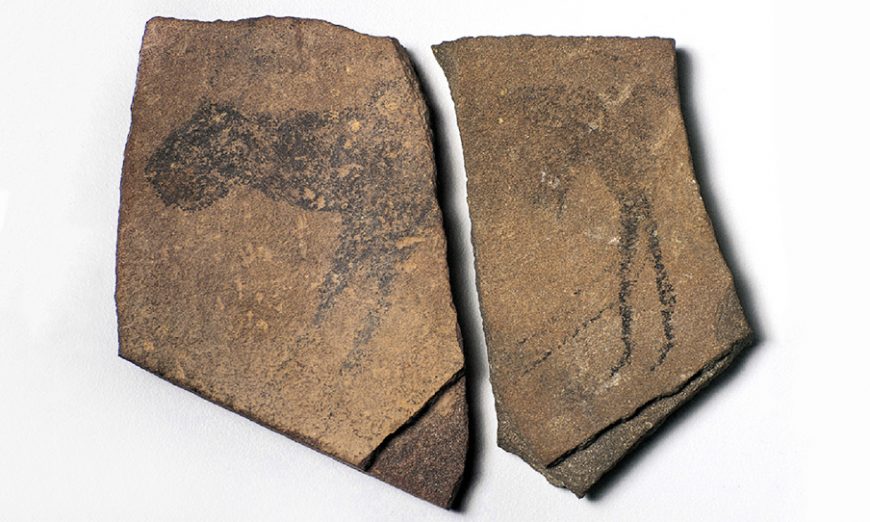
| art mobilier | pocket-size-scale prehistoric fine art that is moveable, such as the Apollo 11 Cave Stones Apollo 11 Cave Stones, Namibia, c. 25,500–25,300 B.C.E |
| avian | something relating to birds |
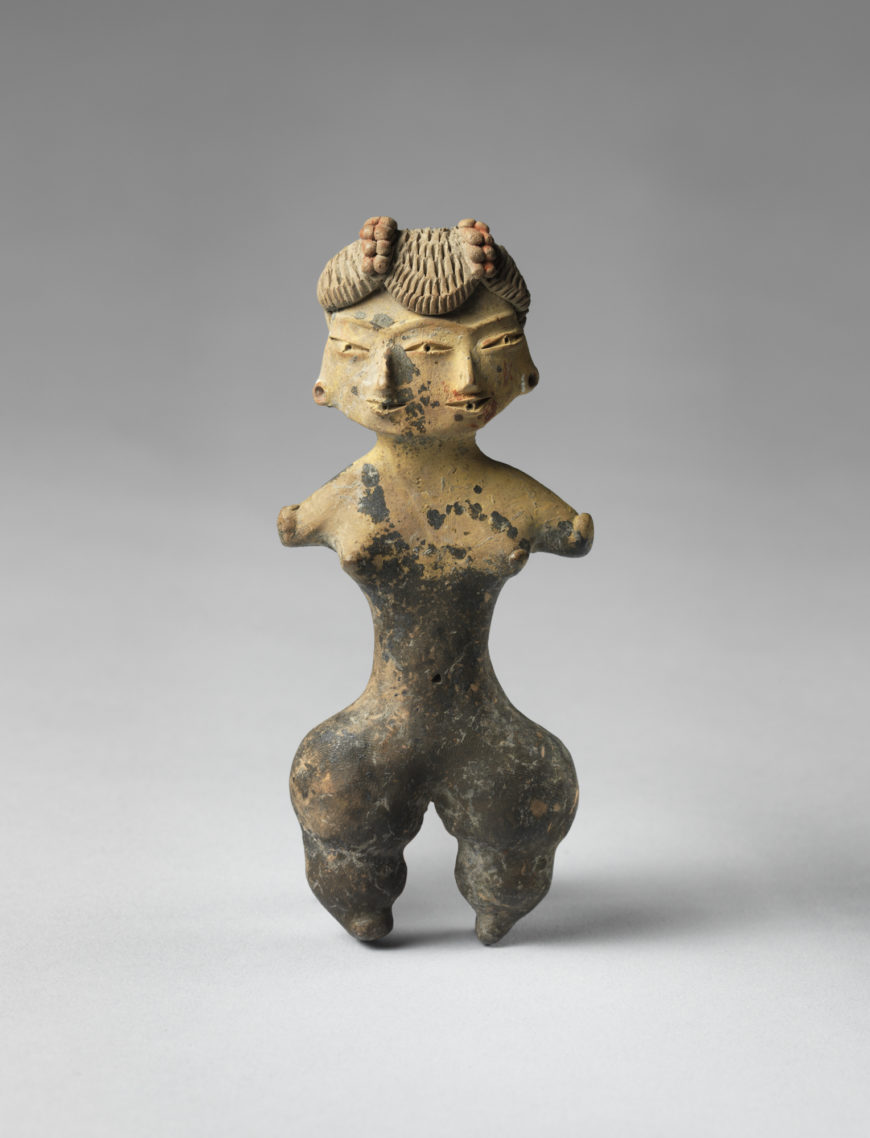
| bicephalic | two-headed figures Tlatilco female figurine |
| Bovid | the Bovidae are the biological family of mammals that includes bison, African buffalo, water buffalo, antelopes, gazelles, sheep, goats, muskoxen, and domestic cattle |
| camelid | a member of the Camelidae family, such equally camels, llamas, and alpacas |
| dentate | something that has a molar-like or serrated border |
| exogenous materials | materials that originated elsewhere |
| Hominids | a primate of family (Hominidae) that includes humans and their fossil ancestors, and also some swell apes; humans evolved from an earlier specifics of hominids |
| Human sapiens | anatomically modern humans who evolved from an earlier species of hominids |
| maize | also known every bit corn; start domesticated by Ethnic peoples in what is today Mexico c. 10,000 years ago |
| Melanesia | refers to a region of the western Pacific that includes the islands and isle groups of Fiji, New Guinea, the Solomon Islands, and Vanuatu |
| Mesoamerica | refers to the diverse civilizations that shared similar cultural characteristics in the geographic areas comprising the mod-day countries of Mexico, Guatemala, Honduras, Belize, El Salvador, Nicaragua, and Costa Rica |
| Federated states of micronesia | the region of the western Pacific referred to as Micronesia includes the Federated states of micronesia, Guam, Republic of kiribati, Mariana Islands, the Marshall islands, Nauru, Palau, and Wake Isle |
| Centre Stone Historic period | a menstruum of African prehistory between the Early Stone Age and the Later Stone Historic period, generally considered to take begun around 280,000 years ago and ended around l–25,000 years agone |
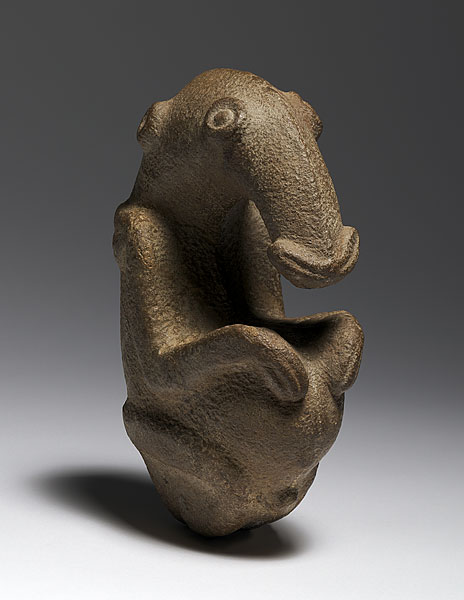
| mortars and pestles | a mortar is a bowl and pestle is an object used to grind confronting the sides of the mortar; they are commonly made of hard fabric such as stone and are ofttimes used to prepare nutrient a pestle known as the Ambum Stone, c. 1500 B.C.East, Papua New Republic of guinea |
| Neanderthals | an extinct species of humans named after the site in which their basic were first discovered—the Neander Valley in Germany; they existed between c. 120,000–35,000 years ago |
| Neolithic period | literally ways "New Stone Age," and dates from the sixth–4th millennium B.C.East. |
| Neolithic Revolution | dates to c. x,00–iii,000 B.C.Eastward, and refers to when humans began to settle into communities, domesticate animals, and grow crops |
| nomad | an private who roams about without a fixed residence |
| oryx | a large grazing antelope |
| paddle-and-anvil technique | a method of smoothing and finishing the walls of mitt-fabricated pottery; the anvil is held against the inner walls while a paddle is used to shape the outer surface |
| Paleolithic | literally ways "Former Stone Historic period," and dates from c. two.5 millions years ago–x,000 B.C.E. It predates the Neolithic flow |
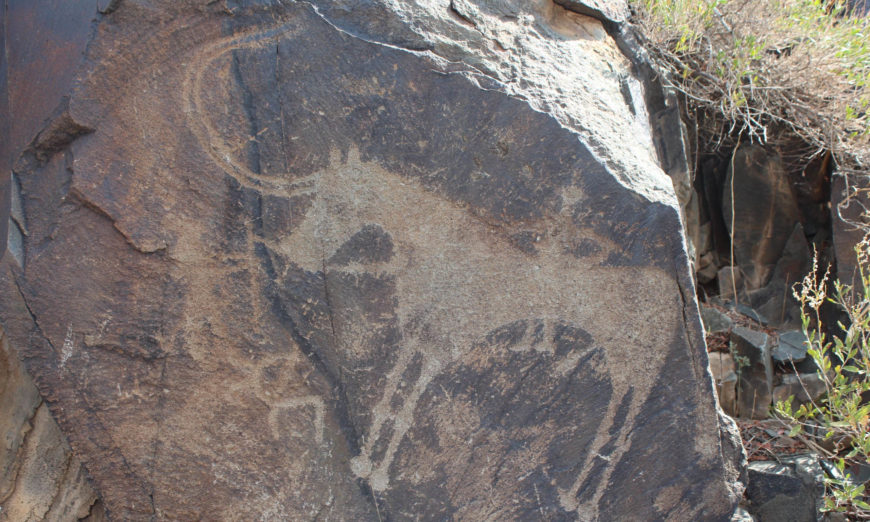
| petroglyph | a rock engraving in which an image has been pecked or cut into the stone Petroglyph from Tamgaly Gorge, dating from the second half of the second millennium B.C.E.–20th century, Kazakhstan |
| Polynesian Triangle | stretches from Hawai'i in the due north to Aotearoa (New Zealand) in the south, and Rapa Nui (Easter Island) in the due east |
| potsherds | fragments of pottery |
| prehistoric | literally means earlier the invention of writing |
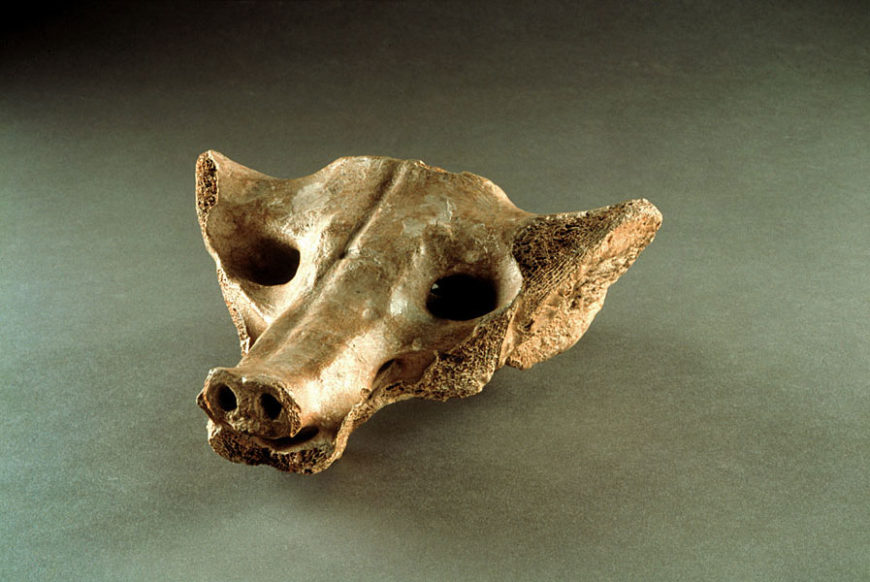
| sacrum | the large triangular bone at the base of operations of the spine Camelid sacrum in the shape of a canine |
| shaman | a kind of priest or healer with powers involving the ability to communicate with spirits of other worlds |
| Shang Dynasty | the primeval Chinese dynasty verified by scholars, ruling from c. 1600–1050 B.C.Eastward. |
| simting bilong tumbuna | literally translates as the "bones of the ancestors"; Enga term for a class of cult objects which were used as powerful ritual mechanisms where ancestors reside |
| slipped pottery | made up of tiny particles of clay suspended in water and tin exist colored with iron oxide or other minerals to decorate the surface of a pot |
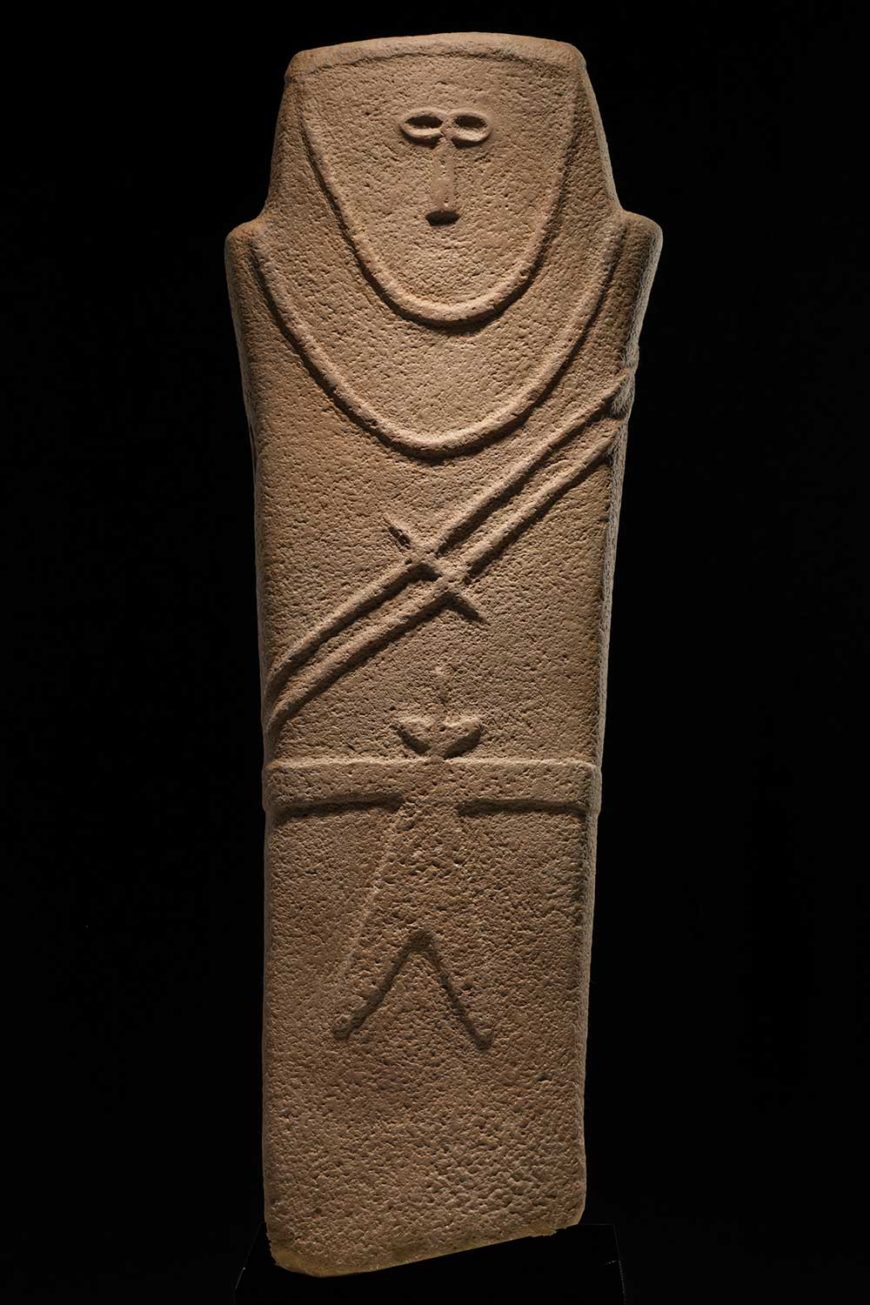
| stele | a vertical stone monument or marker ofttimes inscribed with text or relief carving Anthropomorphic stele, Saudi Arabia, quaternary millennium BCE |
| stratigraphic archaeology | the study of stratification, or layers deposited ane atop another over time |
| temper | oftentimes sand or other added materials, temper reduces the elasticity of clay (how much it shrinks) and helps to avoid cracking during the firing procedure |
| Therianthrope | a supernatural beast that is part animal and function man |
| trilithon | a pair of upright stones with a lintel stone spanning their tops |
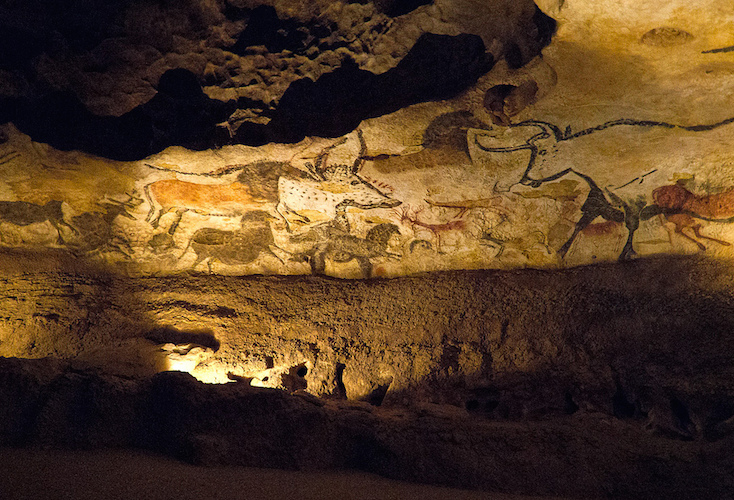
| twisted perspective | when creature bodies are depicted in profile while nosotros see the horns from a more frontal viewpoint Left wall of the Hall of Bulls, Lascaux 2 (replica), original cave: c. 16,000-14,000 B.C.Eastward. |
* Thank you to Nadia Scott for her assist preparing this glossary.
Source: https://smarthistory.org/required-works-for-ap/global-prehistory-overview-guide/glossary-for-ap-content-area-1-global-prehistory/
0 Response to "Camelid Sacrum in the Shape of a Canine Ap Art History"
Post a Comment